1. Existing certifications and their application in marinas
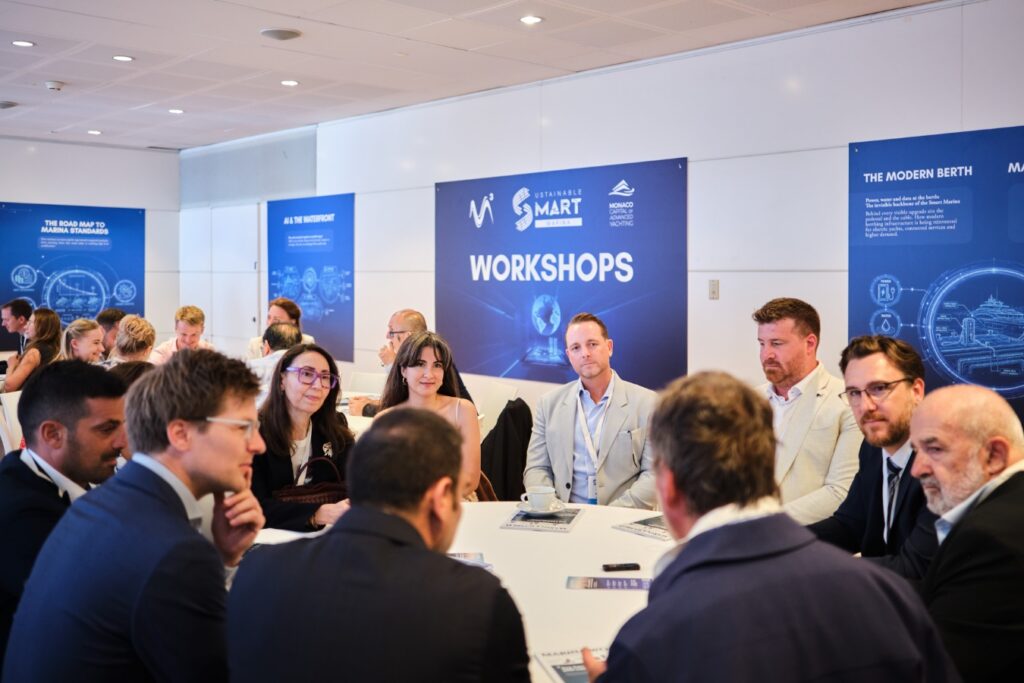
The workshop opened with a discussion of the current landscape of certifications and standards shaping the industry, and their practical implementation in the marinas represented. Almost all participants indicated that their marinas either held, or were in the process of obtaining, well-known certifications such as Golden Anchor, Blue Flag and the S3 Standard, alongside ISO certifications relating to the environment, service quality and safety.
2. Operational relevance and the importance of local context
The discussion then turned to the operational relevance and applicability of certain criteria, particularly environmental ones, and the ways in which they align, or conflict, with the regulatory, economic and social contexts of different marinas.
Oscar emphasised the difficulty of securing universal approval and commitment to a single standard that would be difficult to apply rigidly across all contexts. Drawing on his experience in developing regulations and standards, he described the challenge of consulting institutional and industry representatives from different countries and regions and reaching agreement among them.
Nevertheless, the examples shared during the workshop illustrated the effectiveness and relevance of certain policies. Turkey was cited as an example in relation to greywater and blackwater disposal: under the system described, vessels must present a “blue booklet” when departing from or arriving at a port, providing a record of waste disposal. In Saudi Arabia, environmental requirements and biodiversity protection were described as major challenges and a constant focus for the Red Sea Global teams, particularly during the development of AMAALA, where the protection of natural habitats and local species was given a central role.
The same issue arises with infrastructure outside ports and marinas, particularly waste sorting and recycling. Some countries lack recycling facilities, do not have access to the necessary systems, or have not yet developed them. Sorting waste within a marina becomes ineffective if the downstream treatment chain cannot deliver the intended environmental benefit, even when the marina has carried out the sorting correctly.
Haskoning added an important point on marina engineering and design: beyond aesthetics, marina development must meet operational and regulatory requirements. Ports can also fulfil an institutional role when they provide maritime and border controls. This can be an asset, but can quickly become a major operational and regulatory burden.
Energy was another important part of the discussion. Countries with access to resources, particularly fossil fuels, at attractive prices or even at no cost may have less interest in renewable energy. Where connecting to the main grid is particularly challenging, projects such as AMAALA provide an example by developing their own photovoltaic generation facilities. However, the commitment of AMAALA and Red Sea Global goes further, leading to the next point of discussion.
3. Demonstrating commitment, engaging users and showing results
Beyond complying with regulations and meeting the requirements set by certifications, standards and other labels, marinas need to demonstrate their commitment, investments and efforts in order to gain users’ support and secure their participation in these initiatives.
AMAALA was again presented as an example, requiring 100% electric mobility within its developments. This includes electric transport and taxis from its airport, followed by dedicated parking areas at the entrances to the developments and electric vehicles to transport guests and other users. This approach immerses visitors in a strong environmental commitment that is reflected throughout their experience.
Promotion and education are therefore key to community engagement, as highlighted by Setur Marina and Jeddah Yacht Club, which regularly organise voluntary clean-up operations with users, both within and around their marinas. Participation in biodiversity protection programmes and activities introducing users to aquatic life also plays a fundamental role in raising and developing environmental awareness.
Communicating these initiatives and demonstrating concrete results gives them greater impact than simply displaying a logo or a certification level. Although users may recognise these symbols, they do not, on their own, convey the marina’s investment and involvement.
Plus Marine shared practical solutions for demonstrating results, while also highlighting a tangible return on investment. The company explained that adequately sized power infrastructure, combined with suitable dockside service pedestals, can make it possible to prohibit the use of onboard generators entirely. Metered billing for water and electricity was presented as a way to substantially reduce consumption, with reductions of around 30–40% reported following the installation of these systems. In some cases, they also exposed excessive consumption, such as air-conditioning units left running on boats that had been unoccupied for several weeks.
Moving from a flat rate to consumption-based billing was described as a way not only to encourage users to take responsibility for their consumption, but also to generate an attractive source of revenue for marinas, particularly in the superyacht segment.
Plus Marine also highlighted its commitment to innovation and to developing solutions for energy generation and improved user comfort. The company referred to the forthcoming launch of its self-sufficient floating pontoons, equipped with solar panels and integrated pumps, as a new alternative for mooring outside marinas.
According to the panel, communicating these initiatives and demonstrating their effectiveness helps raise awareness, engage and educate users, and support the effective and efficient delivery of actions, investments and projects. The conclusion was therefore to lead by example through reports, dashboards, displays and communication materials, while also actively involving users in the solutions offered and in concrete community initiatives.
4. Innovation, industry engagement and the role of standards
The evolution of standards and certifications depends above all on innovation and the commitment of industry stakeholders. Becoming a reference by demonstrating concrete actions and results helps inspire both peers and users.
The Smart & Sustainable Standard was presented as sharing this objective, drawing extensively on the best solutions and innovations available in the market. Its scope was described in terms of seven pillars: environment and biodiversity; energy and climate; education and the transmission of maritime values; safety; operational quality; customer experience; and innovation and digitalisation.
The purpose of a standard should be to support the adoption of its criteria and benchmarks, rather than be perceived as a punitive measure or a rigid assessment exercise. In keeping with this approach, S3 was presented as offering a three-year labelling cycle, with an annual review of developments and improvements achieved. Beyond scoring, the audit provides specific recommendations and a prioritised, costed action plan to support decision-making and effective implementation.
Assessing both quantitative and qualitative returns on investment, together with the use of financial, operational and environmental dashboards, also helps secure the commitment of owners and decision-makers.
5. Conclusion: standards as a pathway to improvement
In conclusion, certifications and standards should guide marinas towards improvement and continued development. They should take each marina’s specific context into account, while also providing support and solutions to help it meet their requirements.
Reaching the highest levels of these standards demonstrates solid foundations, whose significance should extend far beyond a certificate, a logo or a flag flying at the marina entrance. Communication, education and user involvement make the efforts undertaken tangible and give them value.
Leading by example and becoming a reference through the actions and projects implemented to achieve these standards is an integral part of marinas’ mission and commitment to increasing the impact, visibility and adoption of certifications and standards.
Some countries also need these examples to adapt their regulations, policies and infrastructure so that they can provide marinas with the support they need, recognising their significant contribution to the attractiveness and international profile of destinations and countries.
Article first published on Smart Marina Connect.