The Forum will bring together finance, governance, business and innovation around a central challenge: how to accelerate solutions for a more sustainable blue economy.
For the marina and yachting industry, this question is highly relevant.
Marinas, yacht clubs and sailing schools are no longer simply technical infrastructures. They are waterfront destinations, environmental interfaces and strategic assets. They influence water quality, energy use, waste management, customer experience, local attractiveness and the relationship between people and the sea.
Yet many facilities still lack a clear framework to translate sustainability ambition into operational action.
This is the role of the S3 Monaco Smart & Sustainable Standard.
A standard designed to move beyond assessment
S3 is an international standard created specifically for marinas, yacht clubs and sailing schools. It was designed to help operators move beyond fragmented labels and isolated initiatives. Many existing certifications indicate where a facility stands. S3 goes further: it helps operators understand what to do next, and how to do it.
The standard provides a structured assessment across the key dimensions of modern waterfront management: resilience, environment, energy, security, service quality, customer experience, innovation, digitalisation, maritime values and knowledge transfer.
But S3 is not only about measurement. Its purpose is to help operators build a clear improvement roadmap, prioritise investments, identify quick wins and structure long-term progress.
Why this matters now
The Blue Economy and Finance Forum highlights one of the major challenges facing the ocean economy: the need to connect capital, projects and solutions capable of scaling up. The 2026 edition will focus on themes including financing the blue economy, decarbonising maritime transport and integrating ocean-related opportunities into global financial strategies. One of the highlights of the Forum will be an innovation hub showcasing companies whose “sustainable solutions are paving the way for a sustainable and regenerative blue economy.”
This is exactly where marinas can play a more active role.
Innovation needs places where it can be applied. Sustainable technologies need real operational environments. Solutions for energy, water, waste, biodiversity, digital operations or customer experience need to connect with the everyday needs of marina operators.
S3 helps create this connection.
By identifying where a facility stands and what it should prioritise, the standard can help operators better understand which solutions are relevant, which investments should come first, and how innovation can support measurable progress.
From sustainable solutions to operational roadmaps
For a marina, adopting a sustainable solution is not simply a question of interest or visibility. It must fit into a wider operational strategy.
A new energy system, a biodiversity initiative, a water monitoring tool or a digital service platform will only create lasting value if it responds to a real need, supports clear objectives and can be integrated into daily operations.
This is why a structured standard matters.
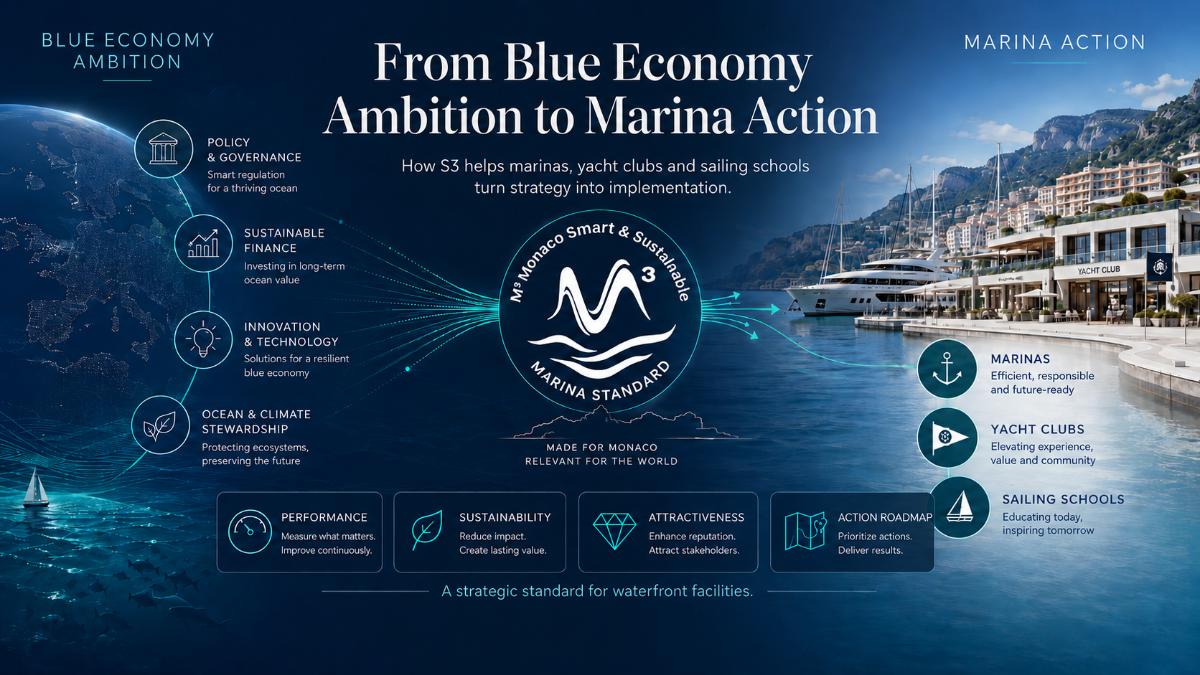
S3 gives operators a practical framework to move from intention to implementation. It helps transform broad sustainability goals into concrete actions: what should be improved, what should be prioritised, what can be achieved quickly and what requires longer-term investment.
In this sense, S3 acts as a bridge between blue economy ambition and marina-level execution.
Marinas as platforms for change
The future of the blue economy will not be shaped only by large-scale finance or policy commitments. It will also depend on the ability of individual facilities to improve, adapt and lead. Marinas, yacht clubs and sailing schools can become practical platforms for change. They can test new solutions, influence user behaviour, support environmental stewardship, improve service standards and transmit maritime knowledge to future generations.
But this requires more than good intentions.
It requires structure, measurement and follow-through.
That is what S3 was created to provide.
As Monaco brings the blue economy conversation into focus at the end of May, the opportunity for the marina sector is clear: to move from ambition to action, and from isolated initiatives to structured transformation.
S3 gives marinas, yacht clubs and sailing schools a framework to do exactly that.
Article first published on Smart Marina Connect.